Start here
Your first topic paper is free.
A full diagnostic on Addition & Subtraction — every skill asked more than once, marked the moment your child finishes. No card. No countdown.
Founding family offer
£29.99 a month, locked for as long as you stay.
For the first 20 families who start a plan, while SillyMaths is in beta. After that, the price goes up.
The 11+ maths diagnostic
What if we’ve been using past papers the wrong way?
Past papers tell you how many marks your child lost.
For Years 4, 5 and 6 — and it does the most in Year 4 and Year 5, while there is still time to find a gap, fix it, and check months later that it stuck.
Our diagnostic assessments are different. Every question is designed to uncover one specific weakness. Once we know which ones are costing marks, we build targeted practice to fix them.
Because a score is only the beginning.
See exactly what to practise next.
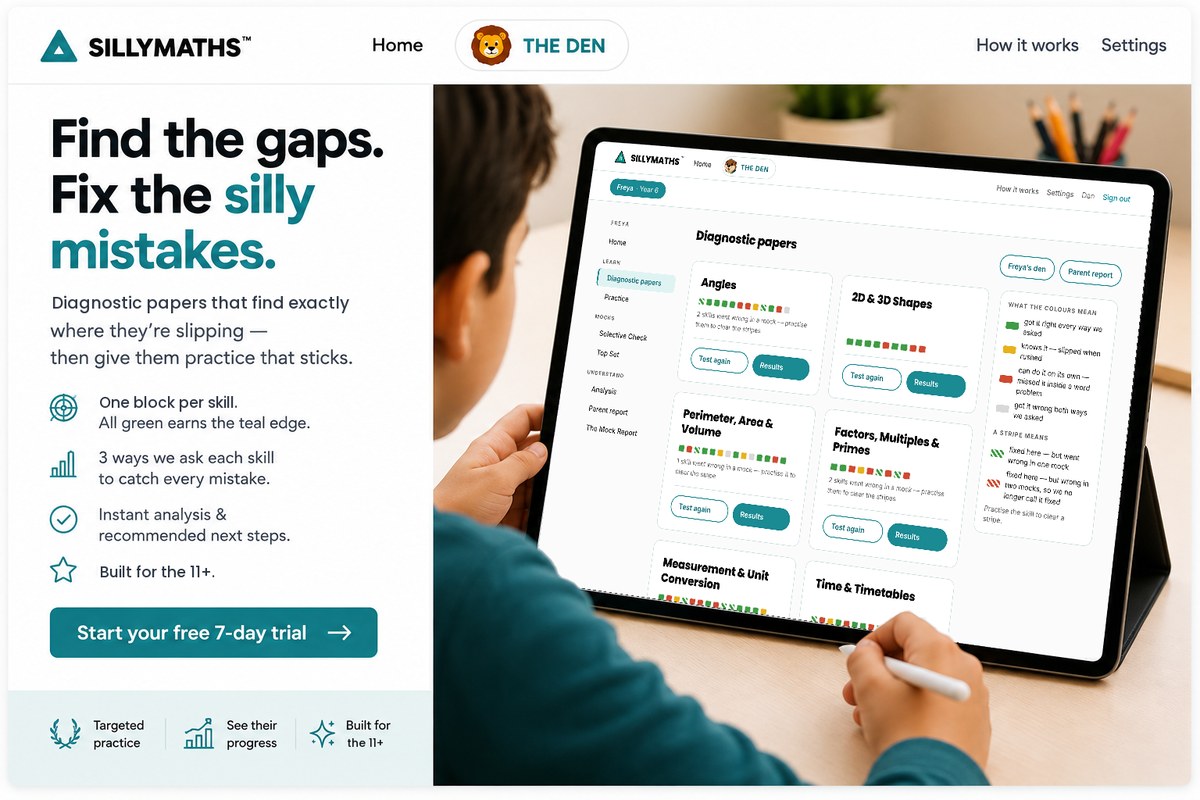
Twenty topics
“Which mistakes keep costing marks?”
One topic, and every mistake in it asked more than once, in a different form each time. So you find out whether it is a gap, something they cannot spot inside a worded question, or rushing.
See the packs →
Twenty papers
“Is my child at the level?”
Forty questions across every topic, at the level the selective schools actually ask for. Sat on screen, marked the moment they finish, and ten papers so you can watch it move.
See the level checks →
Everyone prepares the same way.
Buy a paper. Sit the paper. Mark the paper. Go through the wrong answers. Buy another paper.
Nobody questions it, because that is simply how 11+ preparation has always been done.
We are not saying past papers are bad. We are saying they are incomplete. They tell you what happened. They do not tell you why it happened — so the next paper is chosen by guesswork, and the same marks go missing again.
The loop
- 1Buy a paper
- 2Sit the paper
- 3Mark the paper
- 4Go through the wrong answers
- 5Buy another paper
and round again, for months
Notice what is missing. Nowhere in that loop does anything explain why the marks were lost.
The real value is not knowing how many marks were lost. It is understanding why — so your child knows exactly what to work on next.
Pick the topic that keeps costing marks
One topic, every mistake asked more than once and in different forms. It marks itself the moment your child finishes and names every mistake straight away.
- 1PackIncluded
Place Value & Rounding
Digits, zeros and rounding boundaries — where confident children lose their first marks.
- 2PackIncluded
Addition & Subtraction
Borrowing, missing digits and inverse thinking — the arithmetic slips that hide behind ‘careless’.
- 3PackIncluded
Multiplication & Division
Remainders, factors and sharing problems — including the remainder your child keeps throwing away.
- 4PackIncluded
Fractions
Of-the-rest problems, reverse fractions and bottom-heavy comparisons — the 11+ examiner’s favourite hunting ground.
- 5PackIncluded
Decimals
Place-shifts, decimal ordering and money chains — where one misplaced digit costs the whole question.
- 6PackIncluded
Percentages
Reverse percentages, increase-then-decrease and percentage-of-the-rest — the topic that separates top sets.
- 7PackIncluded
Ratio & Proportion
Sharing in a ratio, linked ratios and ratios that change — where one wrong part throws the whole answer.
- 8PackIncluded
Algebra & Sequences
Function machines, nth terms and think-of-a-number chains — where one jump too many costs the mark.
- 9PackIncluded
Measurement & Unit Conversion
Converting units and the factor-of-ten slips in between — where the unit IS the question.
- 10PackIncluded
Time & Timetables
Clock arithmetic, timetables and the 60-minute trap — plus Roman numerals, read and written.
- 11PackIncluded
Perimeter, Area & Volume
Compound shapes and the classic area–perimeter mix-up — where the unit carries the meaning.
- 12PackIncluded
Angles
Angles on lines, in triangles and around points — where 360° keeps being used in place of 180°.
- 13PackIncluded
2D & 3D Shapes
Properties, nets and counting the faces you cannot see.
- 14PackIncluded
Coordinates & Position
Plotting, reflecting and the missing corner of the shape.
- 15PackIncluded
Statistics & Data Handling
Reading charts precisely and the scale that isn't one-per-square.
- 16PackIncluded
Averages & Spread
Mean, median and mode — and finding the value that got away.
- 17PackIncluded
Money & Financial Reasoning
Change, budgeting and multi-step shopping chains.
- 18PackIncluded
Factors, Multiples & Primes
HCF, LCM and the number properties that hide in plain sight.
- 19PackIncluded
Probability
Fair and unfair games, and what 'likely' actually means.
- 20PackIncluded
Mixed Super-Selective Reasoning
The capstone: multi-topic puzzles at the toughest schools' level.
Want to know where they stand? Sit a mock: forty questions, all twenty topics, fifty minutes.
See the mock papersFind the exact mistake. Then fix it.
It works in three parts: the test your child does, the mistakes explained in plain words, and new practice to fix them.
The pack
The test your child does
- One topic, and every mistake it looks for asked more than once
- Each time in a different form, so one slip cannot fool it
- So you can tell a careless slip from something not yet learned
- A short, simple tip comes with every answer
The diagnosis
What the mistakes are
- You see which mistakes lost the marks — not just a score
- You learn if your child just rushed, or really didn’t understand it
- You see if the same mistake comes back in other topics
- You get the exact questions to go back to, with the mistake named on each
The fix
How to fix them
- New practice sheets on the exact mistake your child made
- New questions every time, so they can’t just remember the answers
- Eight questions on that one mistake — done in ten minutes
- You can watch each mistake get better over time
More papers won’t move the score. Knowing what to fix will.
It’s the same few mistakes
Most lost marks aren’t random — they’re two or three mistakes your child keeps repeating, and a score can’t reveal them.
We name them for you
Instead of a number, you get the exact mistakes behind the lost marks — in plain English, not buried in a score.
You know what to practise
Every result ends with the one or two things to fix — so every practice session targets what’s actually costing marks.
Everyone tells you the topic. We tell you the mistake.
Already have a tutor? Even better.
SillyMaths is not here to replace one. It finds the exact mistake and names it — and whoever is helping, a small misunderstanding can often be fixed in ten minutes, once they know where it is.
That is the part that saves the time: not more hours, but knowing which ten minutes matter.
Built by a maths teacher — thirty years of it — for families preparing for grammar school and other selective entrance exams.
Start with one paper.
See exactly which mistakes are costing the marks — free to try.